 You are here:
Custom Automatic Blind Rivet Machine Checklist: What to Provide
What Do You Need to Provide for a Custom Automatic Blind Rivet Machine? A Preparation Checklist
Most automatic blind rivet machines are a standard main unit plus custom tooling, so the accuracy of a custom build depends entirely on the information the customer provides. Supply a complete data package and an engineer can return a solution and a price range in about 10 minutes. Supply a partial one and the questions start, which can end with the wrong model being quoted. What follows is a checklist you can work straight down.
1. Rivet data (the most important part)
| Item | Details we need | Best way to send it |
|---|---|---|
| Rivet type | Blind rivet or pop rivet, rivet nut, structural rivet, etc. | The name plus a photo of the actual part |
| Dimensions | Head diameter, body diameter, mandrel length, head thickness | The datasheet, or photos with caliper readings |
| Material | Steel, aluminum, stainless steel, copper and any surface finish | Include the material grade if you have it |
| Samples | Enough pieces of every specification to run | Ship them so we can fit the feed channel and test the machine |
2. Workpiece and riveting requirements
Send drawings or photos of the parts to be riveted, with the material, sheet thickness and number of layers marked. Note how many rivet points each part has, how far apart they are and how they are distributed, ideally marked straight on the drawing. Then describe what the joint has to deliver: pull-out force, appearance (are scratches acceptable), water resistance, resistance to loosening. How accessible each point is decides the shape of the gun head and the design of the fixture, so tight spacing or points close to an edge need to be confirmed early.
3. Output and cycle time requirements
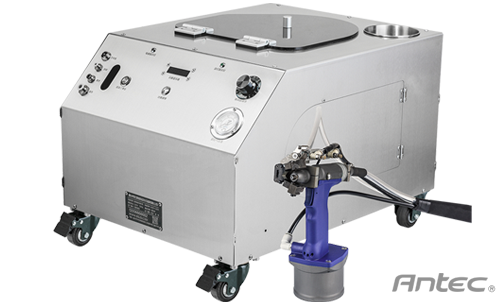
Tell us the daily output, the shift pattern (8 hours a day, two shifts, and so on), the riveting time allowed per part, and the manual cycle time you run today. Those numbers decide whether the answer is a single gun, a dual-gang dual-gun setup or a robotic cell, and they set the machine count and the payback period. A typical Antec model runs about 80 cycles/min and replaces about 3 operators; on a stable batch line, payback is commonly 2-6 months.
4. Machine format and site conditions
| Item | What to tell us |
|---|---|
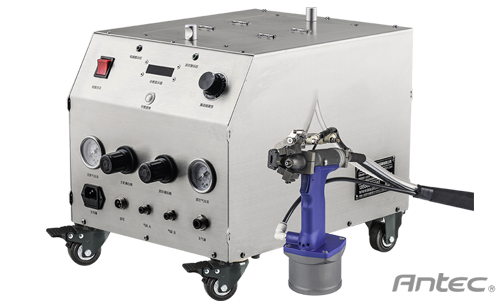
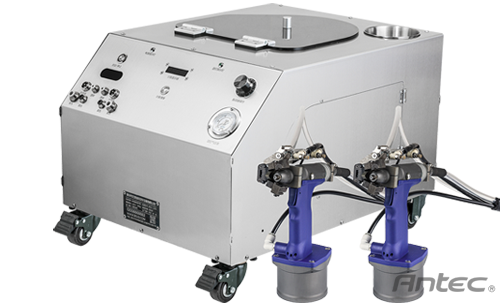
| Machine format | Handheld, benchtop or fixed station, dual-gang dual-gun, or robotic riveting cell |
| Station space | Where the main unit will sit, the distance allowed between the unit and the gun, and how the feed hose will be routed |
| Air and power | Compressor pressure and airflow, site voltage (220V is standard) |
| Running several products | How many rivet specifications you use, how often you change over, and whether you need quick-change nosepieces or multiple feed channels |
| Line integration | Whether the machine has to connect to a production line, PLC signals, or interlock with a robot or fixture |
5. Delivery and commercial terms
Also give us the delivery date you are aiming for, the ship-to address, whether you want on-site installation, commissioning and training, and your invoicing and payment terms. Standard Antec models ship fast from stock. Custom machines are quoted line by line (design, purchased parts, assembly) with the lead time written into the contract. Every machine carries a 1-year warranty plus a 7-day return and 15-day exchange for defects not caused by operator error, and customers worldwide can book a free on-site trial before they commit.
6. Details to check on the quotation and the contract
| Check | What should be spelled out |
|---|---|
| Model and configuration | Main unit model, pull force, single or dual gun, feed method, and the range of rivet sizes the machine can run |
| Spare parts included | Number and size of nosepieces, wear parts such as jaws and pusher pins, and special tools |
| Custom scope | The specific design and cost of feed channels, fixtures, worktables and robot integration |
| What the price covers | Whether tax and freight are included, whether installation and training are charged, and the payment milestones |
| Delivery and acceptance | Ship date, acceptance criteria and liability for late delivery |
| Warranty and service | The 1-year warranty, the terms that apply to the 7-day return and 15-day exchange, spare-part supply and response time |
A proper quotation lets the customer see where every dollar goes. Antec prices a standard machine as one fixed figure per configuration and quotes custom items separately; the quotation is attached to the contract, and we do not cut the price to win the order and add it back at delivery.
Incomplete data is still enough to start with. If you have no drawings, photograph both sides of the part, the rivet positions and the nameplate with your phone, measure the sheet thickness and the rivet with a caliper, and we can begin a first assessment. The engineer will use the photos to list what still has to be confirmed, you work through it item by item, and there is no need to wait for a perfect data package before asking. Bringing us in early is what keeps a riveting process from becoming impossible once the product design is frozen.
Common questions about the data package
Data FAQ
Yes. Send the rivets and the workpiece, photos of the rivet points and your output requirement. Our engineers can help measure and confirm the parameters, and we can run a sample trial at the factory if needed.
Similar specifications can be covered by changing the nosepiece and adjusting the feed channel. Rivets that differ widely are better split across multiple feed channels or several machines, and the data review will say which way to go.
With complete rivet and workpiece information, you get a solution and a price range in about 10 minutes. Complex projects that need custom design usually get a preliminary proposal within 1 business day.
Component and subcontract prices move, so quotations carry a validity date. Pricing on common configurations stays fairly stable. Once the solution is confirmed, lock in your production slot early, because lead times are easier to hold in peak season.
Global customers: send your specs, get a solution and a price range in 10 minutes
Send your rivet specification and workpiece data and an engineer will reply directly. Consultation line: +86 13556668682.
Further reading: Can Any Rivet Specification Run on an Automatic Blind Rivet Machine · How Long Does a Custom Automatic Blind Rivet Machine Take · How Long Does a Custom Automatic Blind Rivet Machine Take
 Previous